 Weekly Read
Two Packets a Day for Thirty Days, and 2,531 Reviews Behind Them
Total Human is a month of morning and evening packets from Onnit of Austin, Texas. I counted what falls out of each one, weighed every line against its own study, and read the loudest review page on this desk.

This is a paid advertisement. Sponsored by Onnit Labs, Inc.

Desmond Clay is the pen name of this desk.
Everything on this page about the carton comes from the seller's own panels, its product page and its help center, read on September 20, 2026.
The customers quoted further down are real and their words are public on the seller's product page.
None was paid, the small pictures beside them are illustrations rather than the reviewers, and the two that carry the seller's buyer mark are noted as such.
A month of anything is a habit, and a habit is a gesture you repeat until you stop noticing it.
This carton asks for two gestures a day, and I want to start there, because the gesture is the part nobody weighs.
You tear the top off a flat foil packet in the morning and tip what is inside onto a plate.
Eight things come out: seven capsules in different colors and one amber softgel.
In the evening you tear open a second packet, and eight more come out.
Sixteen a day, for thirty days, which is four hundred and eighty of them by the time the carton is empty.
Two packets a day. Sixty in the box.
The carton is Total Human, made and sold by Onnit Labs of Austin, Texas, a company with a street address, an email and a toll-free number on its own pages.
The listing calls it more than a multivitamin, and across the two packets it carries ten of the company's own formulas.
One of those ten is the reason a page about memory is looking at a box of vitamins at all.
It is a single capsule of the company's Alpha BRAIN formula, tucked into the morning packet between a bone capsule and a B-vitamin capsule.
The separate bottle that formula comes in says to take two capsules.
This carton gives you one.
Every figure on this page is for one day: one morning packet and one evening packet, as the label directs.
I read the two supplement panels before I read a word of the listing, which is the only order that works.
Between them the panels run to sixty-five printed lines under ten formula names.
Thirty of those lines carry an amount of their own.
The other thirty-five sit inside eight blends that print one total and no split between the names underneath.
Then I read the one trial that exists for the memory capsule, at the age of everyone who was in it.
Then the softgel, against the fish-oil trials in men my age, and the two vitamin lines the panel prints in the largest percentages.
And then I did something I have not done for any other carton on this desk.
I read the review page, all of it, because this one has 2,531 reviews on it, which is more opinion than any product I have written about.
What I found is a real box of real nutrients, most of them at ordinary amounts and three at very large ones, a memory capsule at half the dose of its own bottle with one company-paid trial behind it in adults under 35, a fish-oil softgel at a quarter of the smallest dose that has ever shown anything, eight blends nobody outside the company can see into, shellfish in both packets, and a review page whose own two sub-scores say quality four and value three.
That is the whole page in one breath, and the rest of it is the arithmetic.
It takes a while, because sixty-five lines take a while if you do them properly.
Sixty Packets in a Black Carton, and What Falls Out of One
Open the lid and you are looking at two rows of flat foil, one row marked for the morning and one for the evening.
Nothing rattles, because nothing is loose: the carton is a month of pre-counted handfuls.
That is the whole idea it is selling, and I want to give it its due before I start subtracting.
A man who already buys five or six bottles and lines them up on a windowsill has to remember five or six things every morning and get the count right on each one.
This carton replaces that with a single tear.
Whatever else is true about what is inside, the packaging solves a real problem, and it is the reason the longest-serving reviewer on the seller's page gives for buying it again.

Now the count, in the seller's own order.
The morning packet holds one bone capsule, one Alpha BRAIN capsule, one B-vitamin capsule, one capsule of the formula the carton sells for exercise, one mushroom capsule, two green capsules of spirulina and chlorella, and one softgel of krill oil.
The evening packet holds one capsule whose name on the carton is a word the rules this page follows will not let me print, one vitamin C capsule, the same mushroom capsule again, two mineral capsules, two more green capsules, and the same krill softgel again.
Three of the ten formulas therefore appear twice a day, which is why the carton's ten names come to sixteen swallows.
The directions are plain enough.
Take the morning packet in the morning or early afternoon with a light meal, and the evening packet in the evening with a light meal, before bed.
Under the directions is the usual small type.
It says to consult a clinician before taking this or any other dietary supplement if you have or suspect a condition or take anything daily, and to keep it away from children.
Sixteen swallows, ten names, sixty-five lines, eight of them blends with a total and no split.
One of those lines is the reason this page exists, and it gets a section of its own.
The Company's Own Sentence About the Doses in This Box
Before any of the arithmetic, there is a sentence on the seller's own help center that I would put on the front of the carton if it were up to me.
It says the doses in Total Human are lower than in the separate bottles, and that people buy it to work out what they actually need.
Read that again, because it is unusual.
The company that sells this carton is telling you, in its own words and on its own website, that everything in it is at a reduced amount.
Most sellers do not say that, and the ones that do not say it are usually hoping you will assume the opposite.
This one says it in the same paragraph where it suggests that if you want more of any single formula you should buy that formula's own bottle alongside the carton.
So the honest frame for this whole page is the company's frame, and I am going to hold the carton to it all the way down.
This is not a month of full doses in a convenient wrapper; it is a month of small amounts of ten different things, bought as a way of finding out which ones you care about.
Lower doses, in the seller's own words. That is the frame.
That frame has a consequence worth saying out loud before the sections that follow.
If the memory line matters to you, the carton is not the efficient way to buy it, and the company's help center effectively says so.
It also means the carton cannot be tested as a whole.
No trial has ever put these ten formulas together in a room full of people and measured anything, and there is no sign anyone intends to.
What exists is research on some of the individual lines, at amounts I am about to lay beside the panel. That is a weaker thing than a study of the product, and it is the ordinary situation for almost everything sold this way.
The Morning Packet, Capsule by Capsule
Seven of the eight morning swallows first, and then the one that matters most.
None of these seven is a memory line, and one of them is the strangest thing on either panel.
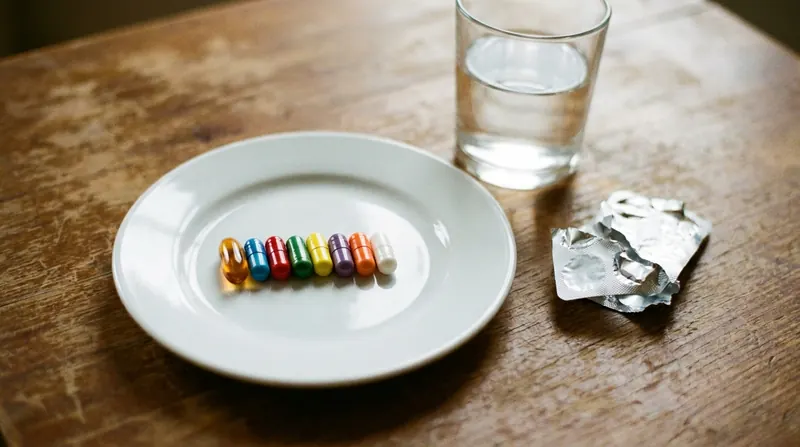
The bone capsule carries vitamin E at 150 percent of the Daily Value, vitamin K2, copper, manganese, a little potassium, boron and a pinch of black pepper extract.
It also carries 226 milligrams of strontium, a mineral with no Daily Value, no explanation anywhere on the listing, and no business being a surprise on the back of a multivitamin.
I went looking for a reason strontium is in there and did not find one printed by the seller.
The ingredient guide linked at the foot of this page has an entry for it, and I would read that entry before your second carton, not after.
The B-vitamin capsule is the most conventional thing in the packet.
Thiamine, riboflavin, folate and pantothenic acid at a day's worth or two, biotin at 1,000 percent of the Daily Value, and 150 milligrams of benfotiamine, which is a fat-soluble relative of thiamine.
The exercise formula is where the carton puts its vitamin B12, at 187 micrograms, which the panel prints as 7,790 percent of the Daily Value.
Beside it sit chromium and a 532-milligram blend of cordyceps, ashwagandha, green tea, rhodiola and astragalus, with no split printed between the five.
Two of those five have research in people worth knowing about, and neither of them is at a knowable amount here.
A sustained-release ashwagandha root extract at 300 milligrams a day for ninety days was associated with better memory and focus scores in 125 adults aged 20 to 55, [1] and a standardized rhodiola extract taken by 56 young physicians on night duty was associated with better scores on tests of mental tiredness over two weeks. [2]
Both of those amounts are specific, and this blend's is not.
Five plants sharing 532 milligrams means the largest any single one of them could be is 532, and the smallest is a pinch; the panel does not say, so neither will I.
There is one line in that blend worth a sentence on its own.
The seller says the carton has no caffeine and no stimulants, and the green tea leaf extract in this blend is the only line that could argue with that, since green tea leaf contains caffeine and the panel does not print how much survives the extraction. [3]
The mushroom capsule is a 500-milligram blend of chaga, cordyceps, agaricus, turkey tail, reishi, maitake, shiitake and astragalus, plus a 202-milligram blend of turmeric, ginger, oregano, lemon peel and black pepper.
Thirteen names, two totals, no split for any of them, and its name on the carton promises something the rules this page follows will not let me repeat, so I will call it the repeating capsule and note that it turns up again at night.
Two green capsules of spirulina and chlorella carry half a gram of each, and the evening packet carries two more.
That is a gram of each by bedtime, which is a real amount of two ordinary algae and, as far as anything I could find on memory in men my age, an amount with nothing to cite behind it.
Seven swallows: ordinary nutrients at mostly ordinary amounts, two mushroom blends with thirteen names and no split, a mineral with no Daily Value and no explanation, and a B12 line at seventy-eight days' worth in one capsule.
That is the morning packet without its eighth capsule.
The eighth is the one you are here for.
The One Capsule in Here That Is Sold for the Mind
Take the eight morning swallows and set one of them apart on the plate.
That one capsule is the entire reason this carton reaches a page about memory, and it is a single capsule out of sixteen.
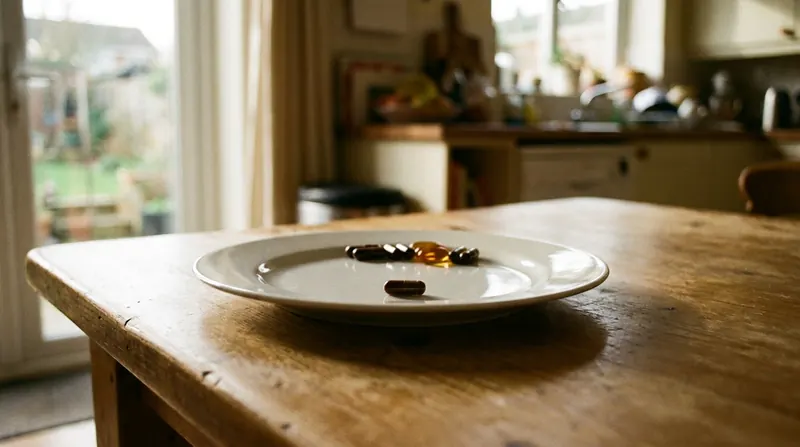
It is the company's Alpha BRAIN formula, the one the listing calls its go-to for sharper thinking.
Inside it are 5 milligrams of vitamin B6, 175 milligrams of cat's claw bark extract, and three blends.
A 325-milligram blend of L-tyrosine, L-theanine, oat straw extract and phosphatidylserine.
A 120-milligram blend of alpha-GPC, bacopa extract and a club moss called Huperzia serrata, and a 30-milligram blend of L-leucine and pterostilbene.
Nine names inside three blends, and no split printed for a single one of the nine.
So nobody reading this label can tell you how much bacopa or how much theanine is in the capsule, and that includes me.
What the label does let you work out is the dose, and the dose is the story.
The separate Alpha BRAIN bottle instructs two capsules per serving, and this carton's morning packet contains one.
Half the bottle's own serving, inside a box sold as the whole man.
The seller's own frequently asked questions say as much, in a roundabout way.
They note that the morning packet includes Alpha BRAIN and ask you to be mindful of the recommended daily dosage of two capsules, which is a strange sentence to print beside a carton that gives you one.
I do not think that is a sleight of hand.
I think it is exactly what the help center says it is: a reduced amount, sold as a way of finding out whether you want the full one.
But it changes what you are buying, and it changes it in a direction the front of the carton does not.
You are buying a taste of a formula, not the formula, and the difference costs a hundred and thirty-eight dollars a month either way.
The Trial of That Capsule, and Everyone Who Was in It
There is one trial of this formula, and it is the reason the name is known at all.
It deserves to be reported properly, which means reporting the good part and the four asterisks that come with it.
Sixty-three adults took a placebo for two weeks, and then either the formula or a placebo for six weeks.
At the end, compared with placebo, the group taking the formula did better on a test of recalling words after a delay and on a test of executive function. [4]
That is a genuine result on two genuine tasks, and delayed word recall is the closest thing in a laboratory to the complaint most men bring to this subject.
Now the asterisks, in the order they matter.
The first is who was in it.
Every one of the sixty-three was between 18 and 35 years old, which means the oldest person in that study was young enough to be my son. [4]
The second is who paid.
The study was funded by Onnit Labs, and one of its authors worked for the company. [4]
The third is how long it ran.
Six weeks, which is one and a half cartons, and nobody has repeated it independently in the decade since.
The fourth is the one I find hardest to get past.
The paper describes the dose as a single daily dose and does not say how many capsules that single dose was, so I cannot tell you whether this carton's one capsule is the trial's amount or half of it. [4]

Put those four together and you have the honest sentence about the best-known line in this carton.
One trial, six weeks, sixty-three people under 35, paid for by the seller, at an amount the paper never states, for a formula this carton supplies at half of what its own bottle directs.
That is not nothing, and it is a long way from what the name on the capsule suggests. I would rather hand you the four asterisks than the headline.
The Nine Names Inside Three Blends, Beside Their Own Trials
The capsule is a blend, but the things inside it are not anonymous.
Several of the nine have research of their own, and it cuts in both directions.
Bacopa is the one with the best paperwork for a man over 55.
In 54 healthy adults aged 65 and older, 300 milligrams a day of a standardized bacopa extract for twelve weeks was associated with better delayed word recall and better performance on a task of ignoring irrelevant information. [5]
A second trial in 98 healthy adults over 55 used the same 300 milligrams a day for the same twelve weeks and reported better verbal learning and delayed recall. [6]
A pooled analysis of nine trials in 518 people found faster performance on two measures of attention speed. [7]
Three studies, one plant, one amount repeated across all of them.
Three hundred milligrams a day, which is more than twice the entire 120-milligram blend that this capsule's bacopa has to share with two other ingredients.
So whatever the split is, the bacopa here cannot reach the amount of the trials in men my age.
That is not a matter of interpretation; it is arithmetic on the panel.
Theanine has a result worth knowing in exactly the right age band.
In men and women aged 50 to 69 with ordinary mental-status scores, a single dose of theanine was associated with a faster reaction time on an attention task and with more correct answers on a working-memory task. [8]
The paper's summary does not state the dose in milligrams, so I cannot line it up against the panel, and I will not pretend otherwise.
It is a single-dose result, which is a different object from thirty days of anything.
Tyrosine is the most conditional of the nine.
A review of the research concluded that it seems to help mainly in short, demanding or stressful situations, and that its usefulness outside those situations appears limited. [9]
Huperzia serrata is the one the panel handles least helpfully.
The label prints the plant extract rather than an amount of huperzine A, so there is no number on the panel to compare with anything.
What research there is used specific microgram doses.
In healthy adults, single doses of 100 or 200 micrograms of huperzine A affected a blood enzyme, and the higher one maintained declarative recall across sessions, but neither improved overall performance. [10]
Phosphatidylserine, oat straw, cat's claw, leucine and pterostilbene round out the capsule.
Of those, phosphatidylserine has the most studied history, and its six-month trial in 78 adults aged 50 to 69 found no overall difference from placebo, with a change only in the subgroup who started with the lowest scores. [11]
One plant in this capsule has repeated trials at exactly 300 milligrams a day in adults over 55, and the entire blend that holds it here weighs 120 milligrams and carries three ingredients. Everything else inside the capsule is unweighed.
What a Blend With No Split Actually Hides
Eight times across these two panels you will see a name, a number, and then a list of ingredients underneath with no numbers at all.
That arrangement has a name in the trade and a consequence for you, and both are worth two minutes.

The number is real: the blend genuinely weighs what it says it weighs.
What is missing is the division, and the division is the only thing that lets you compare a label with a study.
Here is the arithmetic that makes it matter.
If five plants share 532 milligrams, any one of them could be 500 milligrams and the other four a pinch each, or they could be roughly even at about 106 each, and both of those labels look identical from the outside.
The studies, meanwhile, are never vague.
Every trial I have cited on this page gave people a stated number of milligrams a day and wrote it down, because that is what a trial is.
So a blend with no split is not a small omission.
It is the one piece of information that would let a reader check the label against the research, removed.
This carton has eight of them: three inside the memory capsule, one in the exercise formula, two in the repeating mushroom capsule, one in the evening's first capsule and one in the evening's vitamin C capsule.
Thirty-five of the sixty-five printed lines live inside those eight.
I want to be fair about why companies do it.
A split tells a competitor how to copy a formula, and there is a legitimate commercial reason to keep an exact recipe private.
But the cost of that privacy lands entirely on the buyer.
You are asked to pay for a recipe you cannot check, on the strength of a name you cannot look up.
There is a plain way through this, and it costs a telephone call.
The company publishes a toll-free number that answers on weekdays, and asking what the standardization of the bacopa extract is, or how much huperzine A is in that club moss, is a perfectly ordinary question for a customer to put to a seller.
Eight blends, thirty-five names, one total apiece. The number is honest and the division is missing, and the division is the half that would let you compare the panel with a study.
The Softgel, and the Honest Size of 240 Milligrams
The amber thing on the plate is the one line in this carton with a trial in men the right age.
It is also the line where the arithmetic is least flattering, and both of those are true at once.
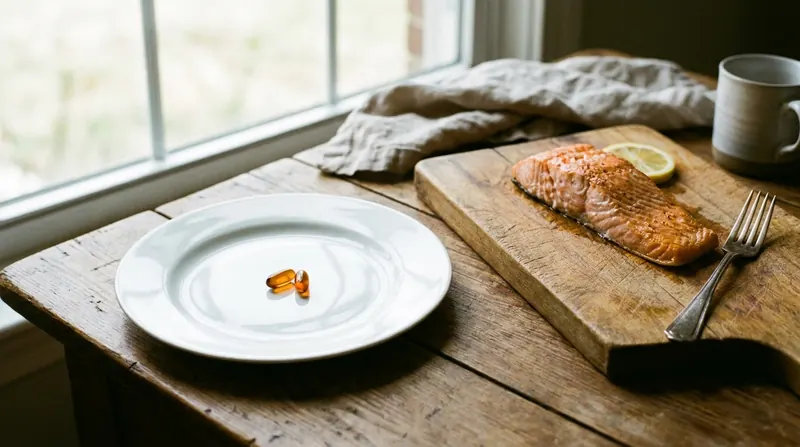
Each packet holds one softgel of 500 milligrams of krill oil, which is oil pressed from a small shrimp-like animal that swims in cold water in enormous numbers.
Inside that 500 milligrams are 120 milligrams of omega-3 fats, 65 of EPA and 30 of DHA, plus 225 milligrams of phospholipids and 100 micrograms of a red pigment called astaxanthin.
Two softgels a day, one in each packet, makes a gram of krill oil and 240 milligrams of omega-3.
Hold that second number, because everything below is measured against it.
Krill oil has one trial in men my age that is worth reading in full.
Forty-five healthy Japanese men aged 61 to 72 took two grams a day of krill oil, or sardine oil, or a placebo, for twelve weeks. [12]
The krill group showed larger increases in blood oxygen in the outer layer of the brain during a working-memory task and a calculation task, and a faster electrical response on a brain trace. [12]
Those are measurements of what the head was doing, not scores on a memory test, and the trial was funded by the company that makes the oil, with four of its employees among the authors. [12]
Now put the two numbers side by side.
That trial gave two grams of krill oil a day; this carton gives one, and its omega-3 content is 240 milligrams.
The fish-oil research is the more sobering comparison.
A pooled analysis of trials in healthy adults found that DHA with EPA improved episodic memory in people with mild memory complaints, and that doses above a gram a day of the two together improved it regardless of where people started. [13]
Above a gram a day.
This carton carries 240 milligrams, which is a little under a quarter of the point where that analysis found anything.
And a gram is not a promise either.
An eighteen-month trial gave 390 healthy adults aged 65 to 90 a much larger 2.3 grams a day of DHA-rich fish oil and found no benefit to their thinking at all, with a small negative effect on psychomotor speed. [14]
Two hundred and forty milligrams is a garnish beside a gram.
The astaxanthin gets one honest sentence and no more.
A pooled analysis of eleven trials in 346 healthy participants found its effect on cognitive accuracy was marginal and not statistically significant, and its effect on reaction time not significant at all. [15]
There is a cheaper way to meet this line, and the picture above is it.
A single serving of salmon carries roughly a gram of omega-3, which is about four of these softgels, and it comes with dinner.
A real fish-oil line at a quarter of its own trial's dose and under a quarter of the amount where the pooled analysis found anything. Honest oil, small spoon, and the fillet on the plate beats both.
The Two Percentages the Panel Prints Largest
Two numbers on these panels look alarming, and one of them mostly is not.
Both deserve explaining rather than raising an eyebrow at.
The first is vitamin B12 at 187 micrograms in the morning packet, which the panel prints as 7,790 percent of the Daily Value.
That is roughly seventy-eight days' worth of the label amount in a single capsule, and it is the largest percentage on either panel.
Here is why it is not as silly as it looks.
The government's own fact sheet on B12 notes that the vitamin has no tolerable upper intake level because of its low potential for toxicity, and that between three and forty-three percent of older adults living at home are short of it, depending on the definition used. [16]
The reason is the stomach, and it is a plumbing problem rather than a diet problem.
A thinning of the stomach lining affects around eight or nine percent of adults aged 65 and older, cutting the acid and the helper protein that prise B12 out of food, while the loose form in a capsule needs neither. [16]
So a large B12 amount in a carton sold to men over 60 is a reasonable guess at a real gap.
What it will not do is sharpen a man who is not short of it, and a blood test is the only way to find out which man you are.
The largest review of the question is blunt about that.
Fourteen trials in 27,882 adults with healthy thinking found that B-vitamin supplements probably have little or no effect on overall cognitive function at any point up to five years. [17]
The second big number is vitamin B6.
The morning capsule carries 5 milligrams and the evening one carries 10, so the carton delivers 15 milligrams a day, which is 880 percent of the Daily Value between the two packets.
That one also has a ceiling worth knowing.
The tolerable upper intake level for B6 is 100 milligrams a day for adults, and the nerve trouble that ceiling exists to avoid has been reported at doses of hundreds of milligrams a day taken for a year or more. [18]
Fifteen milligrams sits well under a hundred, with a good deal of room to spare.
The line to watch is not this carton on its own; it is this carton plus a B-complex you already take, because the amounts add up and nobody adds them for you.
While we are on the mineral lines, one more piece of arithmetic from the evening packet.
Its two mineral capsules carry 125 milligrams of magnesium and its first capsule another 20, making 145 milligrams a day, which is under half the 350-milligram upper level set for supplemental magnesium and well under the 420 milligrams a day recommended for men. [19]
B12 at an amount that makes sense for an older stomach and does nothing for a man who is not short of it, B6 at fifteen milligrams under a hundred-milligram ceiling, and magnesium at under half its supplemental ceiling. The vitamins are the most defensible part of this carton and the part with the least to do with memory.

The Evening Packet, and the Capsule This Page Will Describe but Not Sell
The second tear of the day is the part of this carton a page like this has to handle carefully.
I will describe everything in it, and there is one thing in it I am not allowed to sell you and would not want to.
The two mineral capsules carry 250 milligrams of calcium, 125 of magnesium, iodine from kelp, molybdenum at 330 percent of the Daily Value, and 2 milligrams of boron.
The vitamin C capsule carries 250 milligrams of vitamin C, 6 milligrams of zinc, 75 micrograms of selenium, and a 445-milligram blend of lysine, quercetin and alpha-lipoic acid with no split.
Then the repeating mushroom capsule again, the two green capsules again, and the krill softgel again.
Three formulas doing a second shift, which is how eight morning swallows and eight evening swallows come from ten names.
And then the first capsule in the packet, which is where the care comes in.
Its name on the carton is a word the advertising rules this page follows do not allow, so I will tell you what is in it and leave the name on the box.
It carries 10 milligrams of vitamin B6, vitamin D at 500 international units, niacin as inositol hexanicotinate, and 20 milligrams of magnesium.
Underneath those it carries a 225-milligram blend of valerian root, chamomile, lemon balm and jujube seed with no split, 200 milligrams of L-tryptophan and 75 milligrams of 5-HTP.
Those last two lines are the ones I would put on the pharmacy counter before anything else in this carton.
They are amino acids the body uses to make one of its own signalling chemicals, they are sold in their own right at amounts of this order, and they are exactly the kind of thing that argues with other things.
If you take anything daily at all, and especially anything that acts on how you feel, that capsule is a question for the pharmacist before it is a question for your wallet.
I am not telling you it is dangerous, and I am not qualified to; I am telling you it is the line on this label a trained person should see.
The blend above them is worth a paragraph too.
The government's fact sheet on valerian says the evidence from clinical studies of its usual use is inconclusive, that there is no scientific agreement on how it works, that few adverse events have been reported in trials, and that it might add to the effect of sedatives. [20]
That is four sentences of honest uncertainty from the government's own page, and it is more than the carton says.
None of that is about memory, which is the other reason it gets described here and sold nowhere.
An evening packet of minerals, vitamin C, mushrooms, greens and krill, plus one capsule with two amino-acid lines and a four-herb blend that belong at a pharmacy counter before they belong in you. Described in full, sold not at all.
Shellfish in Both Packets, and the Small Type Under the Panel
This is the shortest section on the page and the one most likely to matter to somebody reading it.
Both panels carry an allergen line, and the two lines are not the same.
The morning panel says the packet contains shellfish, from the krill.
The evening panel says it contains fish, listing cod and herring, and shellfish, listing krill, lobster and shrimp, because the organic kelp in its mineral capsules is a naturally sourced material that may carry both.
So a man who avoids shellfish cannot take either packet, and a man who avoids fish cannot take the evening one.
The seller's own frequently asked questions mention only the krill, which is why I am repeating the panel instead.
One more line of small type belongs with it.
The krill softgel is made of gelatin, so neither packet suits anyone avoiding animal products, while the other nine formulas are in vegetable capsules of hypromellose.
I do not raise any of this to be alarming.
I raise it because it is printed in the smallest type on the carton and it is the one thing on either panel that could actually spoil somebody's week.
Two Thousand Five Hundred Thirty-One Reviews, and What They Actually Say
Now the part of this carton nothing else on my desk can match.
The seller's product page carries 2,531 reviews with an average of 4.33 stars, which is more opinion than I have ever had to read for one product.

Underneath the stars, the same review system prints two smaller scores that most people scroll straight past.
Quality of product, four out of five; value of product, three out of five.
Those two numbers are the honest summary of the whole page, and everything I read bore them out.
People think the contents are good and they think the price is not.
Here is the distribution, because an average hides its own shape.
One thousand seven hundred and eighty of the reviews are five stars, 276 are four, 196 are three, 98 are two and 181 are one.
Read that bottom end properly.
Almost three hundred people out of two and a half thousand gave this carton one or two stars, which is a bigger minority than a 4.33 average suggests.
Now the part that changed how I read all of it.
The review system marks only five of those 2,531 reviews as written by a customer it could confirm had bought the carton, and all five of those were written this month.
The reason is technical rather than sinister.
The seller moved its shop onto a new platform recently, and the 2,526 older reviews were carried across from the previous system without the marking that confirms a purchase.
So the number on the page is 2,531 and the number of opinions the system itself can vouch for is five.
Both of those facts are true at the same time, and a page that quotes the first without the second is not being straight with you.
I read the most recent 549 of them, which is as far back as the system would show me in date order.
Then I threw out most of what I read, and you are owed the reasons.
I threw out the ones that talk about how they slept, how they felt or how much energy they had, because the rules this page follows do not allow that language and because none of it can be checked.
I threw out the ones that name a condition a clinician gave them, and the ones that compare the carton with something from a pharmacy.
I threw out the ones from customers in Canada and Japan complaining about duties and postage, since the seller's own website says it serves the United States only.
I threw out the ones from 2020 about subscriptions charged and not delivered, because a shipping complaint from six years ago tells you about a warehouse and not a carton.
And I threw out the ones with a rating and two words.
What was left is the five below, and the word that runs through all 549 of them is price.
The Five Reviews I Kept
Two of these carry the seller's buyer mark and three do not, and I have kept a three-star and a two-star on purpose.
These are real customers quoted word for word from the seller's own product page, and the small pictures beside them are illustrations rather than the reviewers.

It's been over a half year since I began using the Total Human product. So far, so good. The convenience factor and the money savings are a definite plus (vis-a-vis buying a bunch of separate bottles).

Great product but expensive.

Great product, the day and night packages are perfect if your traveling or busy no need for all the separate bottles.

So far so good. Pretty complete vitamin package, as always with onnit it is overpriced

I tried this and although I think the product was decent, I would not purchase this because of the price.
Read them the way I did, in the order they sit.
David has used it for more than half a year, and the reason he gives is the tear: two packets instead of a row of bottles, and money saved against buying them separately.
Stuart has been using it for a year or more and gives it three stars.
He rates the value one out of five while still calling it a great product, which is the most precise summary anyone on that page has managed in four words.
Gary says the same thing David does from the other end, and mentions travelling.
A man who is away from his own windowsill for a week is exactly the man a pre-counted packet was designed for.
J B calls it a complete vitamin package and overpriced in the same sentence.
Brett tried it, thought it decent, and will not buy it again because of what it costs.
Not one of the five says anything happened to their memory, and none of them could honestly, because no trial has ever tested this carton. Convenient and expensive, five times over, is the true shape of 2,531 opinions.
One last word about the 4.33 itself.
An average of two and a half thousand opinions measures how satisfied those people were with a purchase, which is a real thing and a completely different thing from whether any line on the panel did anything.
Four Cheaper Explanations, Before You Spend a Hundred and Thirty-Eight Dollars
There is a conversation I have with every man who asks me about a carton, and it comes before the carton.
None of these four costs anything, and each of them is more likely to be the answer than anything in a foil packet.

The first is water.
In 1,111 adults aged 60 to 89, the third of them who were measurably short of water slipped faster on a test of processing speed than the rest, independently of their circumstances and their health. [21]
A review of eighteen studies covering 33,707 adults over 60 concluded that the evidence tying being short of water to poorer thinking is real but sparse. [22]
That is an honest way to put it, and it is still the cheapest thing on this page to act on.
Two glasses of water before noon costs nothing and tests faster than any carton.
The second is the hour of the day.
Almost everybody is worse at names at four in the afternoon than at ten in the morning, and a man who only notices himself after lunch is measuring the hour rather than himself.
The third is hearing.
Straining to catch a name across a room with a television on looks exactly like failing to remember it, and the difference matters because one of those two is worth an appointment this month.
The fourth is the shape of what you eat, measured in years rather than weeks.
In a three-year trial of 604 older adults, a group eating the MIND pattern of vegetables, berries, nuts, whole grains, beans, fish and olive oil and a group simply eating a little less both improved their thinking scores by about the same amount. [23]
Read that one carefully, because it cuts both ways.
The pattern helped, plain attention to the plate helped, and neither of them beat the other. [23]
I am not putting these four ahead of the carton to be difficult.
I am putting them there because if one of them is your answer, the carton will look like it worked and you will pay a hundred and thirty-eight dollars a month for the credit.
Water, the hour of the day, your hearing, and the shape of your plate. Four things that cost nothing, all of them more likely than a capsule, and all of them worth ruling out before you order.
Eight Things Sixteen Capsules a Day Will Not Do
- They will not give you the full dose of the one capsule sold for the mind. The bottle it comes from directs two capsules; this carton gives one, and the seller's help center says the amounts here are lower.
- They will not give you a trial in men your age for that capsule. The one trial ran six weeks in 63 adults aged 18 to 35, paid for by the seller, at an amount the paper does not state. [4]
- They will not reach the bacopa amount of its own studies. Three trials used 300 milligrams a day; the entire blend holding this capsule's bacopa weighs 120. [5] [6] [7]
- They will not reach the fish-oil amounts of the trials. Two softgels are 240 milligrams of omega-3, and the pooled analysis found its effect above a gram a day. [13]
- They will not tell you what is inside the blends. Thirty-five of the sixty-five printed lines sit inside eight totals with no split.
- They will not come without shellfish. Krill is in both packets, and the kelp in the evening packet may carry fish and shellfish as well.
- They will not act on anything a clinician has named. This is a dietary supplement and both its own panels carry the sentence that says so.
- They will not come with 2,531 confirmed opinions. Five of those reviews carry the seller's buyer mark, and the value sub-score is three out of five.
If that list irritates you, I would rather you were irritated on day one than on day thirty-one.
By then the plan may have charged you again, and you will have swallowed four hundred and eighty capsules to test one of them.
If You Do Buy It: One Carton, Two Hours, and a Notebook
If you are going to spend the money, spend it as a test with a date on it.
And take the pharmacist's two minutes before the first tear, not after the last one.
- Buy one carton rather than the monthly plan. Thirty days is the test, and the seller's promise clock runs thirty days from the purchase date.
- Take both panels to the pharmacist before you open a packet, along with everything else you take. The evening capsule's two amino acids, the krill, the kelp iodine and the B vitamins are the four things to name out loud.
- Ask your clinician for a B12 level if nobody has checked one in a few years. The largest line on the panel only matters if you are short, and a blood test is the only way to know.
- Keep the order confirmation in a folder. The promise is claimed through the seller's contact page with the order number, within thirty days of purchase, and you keep the carton.
- Take the morning packet with breakfast and the evening packet with supper, at the same two hours every day. Sixteen capsules on the days you remember tests nothing at all.
- Do not start it in the same week you change anything else. One change at a time, or the month tells you nothing.
- Write one line a day in a notebook. Not sharper or foggier: what you were doing at ten in the morning, and how it went.
- On the last morning, read the thirty lines beside thirty lines from the month before. That is the only trial of this carton you are ever going to get.

Look at that list the way I do.
Seven of the eight things on it cost nothing.
The carton is the one you pay for, and the notebook is the one that tells you the truth.
Thirty lines written at the same hour will tell you more about your own mornings than any page on the internet, this one included.
Who It Suits, and Who Should Leave It on the Shelf
This is worth a look if:
- You already buy five or six separate bottles and would rather they arrived pre-counted in two packets. That is the best reason on the seller's page and the one its longest-serving reviewer gives.
- You travel, or your mornings are unpredictable, and a row of bottles on a windowsill has stopped working.
- You want a large B12 amount and you have read why that can make sense for a stomach over 65. [16]
- You can hold two ideas at once: a real carton of real nutrients, and a memory capsule at half its own bottle's dose with one company-paid trial in adults under 35.
- You will take both panels to the pharmacist before the first tear, and you take nothing daily that the evening capsule argues with.
- You will run one carton as a thirty-day test with a notebook, and keep the confirmation.
Leave it on the shelf if:
- You want the memory capsule at its full amount. Buy that formula's own bottle instead, which is what the seller's own help center suggests.
- You want a trial in men your age. There is not one for that capsule, and the krill trial measured blood oxygen in 45 men rather than memory scores. [12]
- You are allergic to shellfish or to fish. Krill is in both packets and the kelp may carry both.
- You already take a multivitamin or a B complex. You would be doubling most of the B lines and adding them to each other.
- You take anything daily, and especially anything that acts on how you feel. The evening capsule is a pharmacy question first and a purchase second.
- You want to know what is inside the blends before you pay. There are eight of them and not one carries a split.
- A hundred and thirty-eight dollars a month is a stretch. Nearly three hundred reviewers out of two and a half thousand said exactly that in one or two stars.
Where It's Sold, What Shipping Costs, and a Thirty-Day Promise With a Wrinkle
The carton is sold by Onnit on its own website, and that is the only place this page sends you.
The company is findable and reachable, which is the first thing I check and the thing half the listings that reach this desk fail.

Onnit Labs has a street address in Austin, an email for customer service and a toll-free number that answers on weekdays between ten and six eastern time.
Its help center is, to its credit, the place where the sentence about lower amounts appears, and the same page suggests buying a separate bottle of whichever formula you want more of.
The price is on the seller's page and not on this one, because prices change and a printed price goes stale in a week.
On the day I read it, one carton was a hundred and thirty-eight dollars, which is four dollars and sixty cents a day, and the page offers a monthly plan at fifteen percent off.
Look at the buttons before you click one.
A monthly plan for sixteen capsules a day you have never taken is a bet, and the only trial in the carton lasted six weeks in people under 35.
Shipping first, because it is simple.
The seller ships at no charge on orders of a hundred dollars or more within the forty-eight contiguous states, and one carton clears that line comfortably; Alaska, Hawaii and the territories pay postage.
Now the promise, which is generous and has one wrinkle in it.
Read this part twice, because two pages on the same website do not say the same thing.
The help center says that if your first experience with one of its products is not what you hoped, the company will refund the product cost within thirty days of purchase, with no price limit, and that you keep the carton because no return is required.
You claim it by messaging the company through its contact page with your order number, and postage charges are not refunded.
The company's separate refund policy page says something narrower.
It says the keep-it promise applies only to first-time purchases of selected products under forty dollars, which this carton at a hundred and thirty-eight is not.
Those two pages contradict each other, and the more generous one is the one on the help center.
I would email and ask which page governs before ordering, and keep the reply.
Ask which page governs. Then keep the answer.
One more condition worth reading slowly.
The promise covers your first purchase of each product, once per customer, and only on orders placed on the seller's own website, so a carton bought anywhere else is outside it.
Shipping included on one carton, a thirty-day promise from the purchase date with nothing to mail back, and a second page on the same website that narrows it to products under forty dollars. Ask by email, and keep the reply with your confirmation.
Every one of the sixty-five lines across the two panels is written out in the ingredient guide linked at the foot of this page: what each one is, what the research does and does not show, at what amount, in whom, and who paid for it.
Print it and take it to the pharmacy counter with both panels before the first tear, because that is exactly what it was written for.
Sixty packets, thirty mornings and thirty evenings
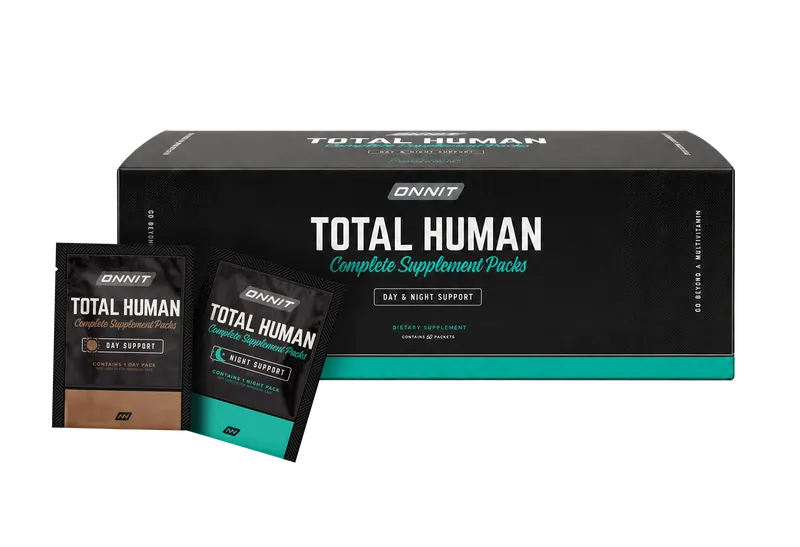
A day packet and a night packet, eight capsules apiece, that bundle ten Onnit formulas at reduced doses, from an Austin, Texas company.
SEE THE CARTON AND THE CURRENT PRICESold by Onnit Labs, Inc. of Austin, Texas · 60 packets, 16 capsules and softgels a day, 10 formulas · shipping at no charge on one carton in the contiguous states · thirty days from purchase on a first order, claimed through the seller's contact page, with a second page on the same site that reads differently · contains shellfish in both packets, and fish and shellfish in the evening one
What readers ask before the first packet
Is this medicine?
No. It is a dietary supplement: ten formulas of vitamins, minerals, herbs, mushrooms, amino acids and krill oil, split across two packets a day.
How much of the memory capsule is in a packet?
One capsule of Alpha BRAIN, where the separate bottle directs two. The seller's help center says the amounts in this carton are lower than in its bottles.
What does the trial of that capsule actually show?
One six-week trial in 63 adults aged 18 to 35, paid for by the seller, reported better delayed word recall and executive function than placebo. [4] The paper does not say how many capsules the daily dose was.
Does it have caffeine?
The seller says it has none. The only line that could argue is a green tea leaf extract inside a blend with no split, and the panel does not print its caffeine. [3]
What is in the evening packet?
Two mineral capsules, a vitamin C capsule, the repeating mushroom capsule, two green capsules, the krill softgel and one capsule carrying B6, vitamin D, niacin, a four-herb blend, 200 milligrams of L-tryptophan and 75 of 5-HTP.
Can I take it with what I already take?
Ask your pharmacist first and bring both panels. The evening capsule's two amino acids, the krill, the kelp iodine and the B vitamins are the four things to name.
Does it contain shellfish?
Yes, in both packets, from the krill. The evening panel adds fish and shellfish because of the kelp, and the softgel is gelatin.
Are the reviews real?
They are public on the seller's page: 2,531 of them averaging 4.33 stars, with quality scored four and value three. Only five carry the seller's buyer mark, because the older ones were carried over from another system.
What if it arrives and I do not want it?
The help center gives thirty days from the purchase date on a first order, claimed with your order number through the contact page, and you keep the carton. The seller's separate refund policy page reads differently, so ask which one governs.
The Whole Carton in Ten Lines
- A black carton of thirty morning packets and thirty evening packets from Onnit Labs of Austin, Texas: sixteen capsules and softgels a day across ten formulas, sixty-five printed lines and eight blends with no split.
- The seller's own help center says the amounts in this carton are lower than in its separate bottles, and suggests buying a bottle of whichever formula you want more of.
- The memory line is one Alpha BRAIN capsule where its own bottle directs two, with a single six-week trial in 63 adults aged 18 to 35, paid for by the seller, at an amount the paper never states. [4]
- The bacopa inside that capsule cannot reach the 300 milligrams a day used in three trials in adults over 55, because the whole blend holding it weighs 120 milligrams. [5] [6] [7]
- The krill softgels give 240 milligrams of omega-3 a day, against two grams of krill oil in the maker-funded trial in men aged 61 to 72 [12] and above a gram a day in the pooled fish-oil analysis. [13] The astaxanthin's own pooled trials found nothing significant. [15]
- Vitamin B12 at seventy-eight days' worth makes sense for an older stomach [16] and does nothing for a man who is not short of it. [17] B6 at fifteen milligrams sits well under its hundred-milligram ceiling. [18]
- The evening packet carries minerals, vitamin C, mushrooms, greens, krill and one capsule with L-tryptophan, 5-HTP and a four-herb blend including valerian, [20] which belongs at the pharmacy counter first.
- Shellfish in both packets, fish and shellfish in the evening one, and a gelatin softgel.
- 2,531 reviews averaging 4.33 stars, quality four and value three, with five carrying the seller's buyer mark; five quoted here, none paid, and the word running through all of them is price.
- Before any of it: water, the hour of the day, your hearing, and the shape of your plate. [21] [22] [23]

What Two Packets a Day Are Actually Worth
Here is the whole thing in one breath.
A real carton of real nutrients, most of them at sensible amounts and one at seventy-eight days' worth, packed so that a man does not have to count out six bottles before breakfast.
One capsule for the mind at half of what its own bottle directs, with a single company-paid trial in people under 35 at an amount nobody wrote down.
A softgel of good oil at a quarter of the smallest amount that has ever shown anything, and a fillet of salmon that carries four of them.
Eight blends you cannot see into, shellfish in both packets, and one evening capsule a pharmacist should meet before you do.
And a review page that says convenient and expensive two and a half thousand times, with five opinions the system itself can vouch for.
If you are a man who already buys six bottles, who has read that the memory capsule is half a dose with a young trial behind it, and who will take both panels to the pharmacist and run thirty days with a notebook, that is worth one carton.
Not because of the 4.33.
Because at the end of thirty mornings you will know exactly what sixteen capsules are worth to you, and exactly which one of them you were actually buying.
Buy one carton, take both panels to the pharmacist before the first tear, keep the two hours the same every day, ask your clinician for a B12 level, keep the confirmation and ask which promise page governs, and write one line a day. The notebook is a better judge than I am, and the carton cannot tell you which of its sixteen capsules did anything.

One carton, from the company that prints both panels
A day packet and a night packet, eight capsules apiece, that bundle ten Onnit formulas at reduced doses, from an Austin, Texas company.
SEE THE CARTON AND THE CURRENT PRICEOnnit Labs, Inc., Austin, Texas · 30 morning packets and 30 evening packets · 16 capsules and softgels a day · thirty days from purchase on a first order, with nothing to mail back · contains shellfish
P.S. If you take one thing from this page, take the two numbers.
One capsule, where the bottle it comes from directs two.
Thirty-five, the number of printed lines on these panels that sit inside a blend with no amount of their own.
P.P.S. If the afternoon haze has been with you for a year, and it is there before the coffee too, talk to your own clinician before you buy anything at all.
Two packets a day is a large habit built around one small capsule.
It was never going to answer a question a clinician answers in fifteen minutes and a blood test, and that blood test is also the only way to know whether the biggest line on the panel was ever yours to need.